
If you are shopping for a solar pump, your first instinct is probably to look for the Horsepower (HP). In the world of gas engines and old AC motors, more HP meant more “muscle”, more water drawn.
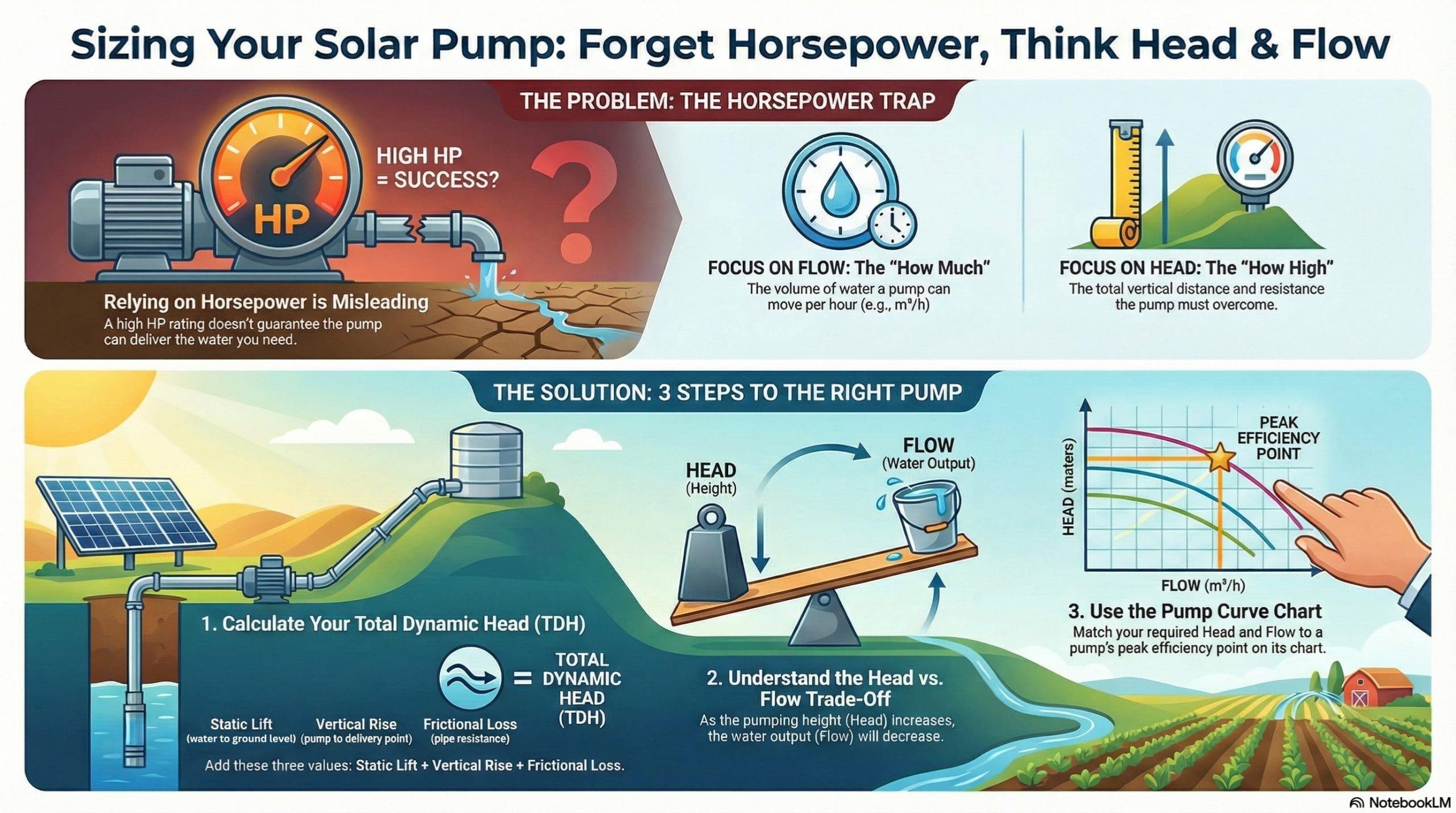
However, in solar water pumping, simply looking at horsepower can be a trap. If you buy a “1 HP” pump without looking at the Head and Flow, you might end up with a system that can’t push water up your field – or one that delivers a tiny trickle when you need a flood!
To pick the right pump, consider these two factors:
- Flow (The “How Much”) – This is the volume of water moved per hour.
- Head (The “How High”) – This is the total vertical distance and resistance the pump must overcome, its also referred to as the Total Dynamic Head (TDH)
To find your TDH, add these three numbers together:
- Static Lift – Height from the water level in the borehole to the ground
- Vertical Rise – Height from the ground to the top of your tank
- Frictional Loss – Resistance from pipe length and that of bends
Total Head would be the sum of the 3 figures above.
Now, here’s the thing, head and flow share an inverted relationship. As the “Head” (height) increases, the “Flow” (output) decreases. A pump rated for “8 m3/h” might only give you that flow at a head of 10m. At a head of 100m, that same pump might only give you 1 m3/h.
After understanding all this, this brings us to something that’s called a pump curve. A pump curve shows how a pump performs as a function of head and flow. When picking your pump, look at the pump curve to ensure you pick a pump whose peak efficiency point matches your operating conditions.
Still feeling overwhelmed? Don’t worry, visit us instore and one of our dedicated technical salespeople will work it all out for you to find the best pump for your needs.